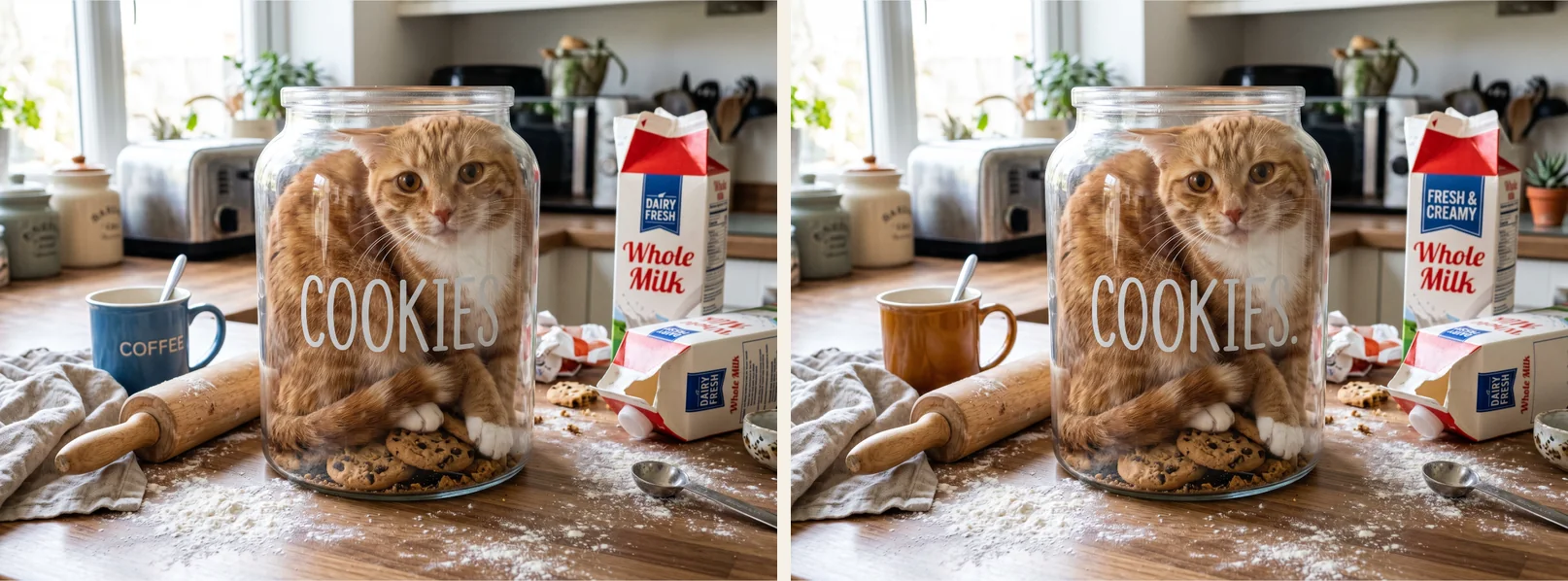
Search for spot-the-difference online and you'll find a lot of big promises. Better memory. Sharper focus. Protection against dementia. Five minutes a day and your brain stays young.
We make a spot-the-difference game. It would be really convenient for us if all of that were true, and we could just put it on the home page. We looked into it, and most of it doesn't hold up. What's left is still interesting, though, and a lot more honest.
What you're actually practicing
The game uses a few quite specific skills. The main one is visual search, going through a scene systematically to find something. That happens to be one of the most studied topics in perception research. Then there's visual working memory, which is what holds a few details in your head while your eyes jump to the other picture. You also need to stay focused for a few minutes, and to tell apart things that look nearly the same, like two very similar blues.
If you play regularly, you'll get better at the game. Nobody disputes that. You'll develop a way of searching, learn where puzzle makers like to hide things, and get faster.
The real question
The interesting question is whether getting better at the game makes you better at other things. Remembering names, concentrating at work, staying sharp when you're older. Psychologists call this transfer, and they separate two kinds.
Near transfer means you also get better at tasks that are very similar to the one you practiced. Get faster at one kind of visual puzzle, and you'll probably get faster at a similar one. Far transfer means improving something quite different, like general intelligence, everyday memory, or grades at school.
The most thorough look at this so far was published in 2016 by a group of researchers led by Daniel Simons (Simons et al., 2016). They went through the studies that brain training companies themselves cited as evidence. Put simply, they found that training reliably makes you better at the trained task, and sometimes at very similar tasks. Evidence that it improves broader, everyday abilities was weak, and many of the studies had design problems that made them hard to interpret.
So near transfer is real. Far transfer is unproven at best.
What about staying sharp in old age?
You'll also find studies showing that older people who do puzzles regularly tend to score better on cognitive tests. That might well be true. But most of those studies are observational. They show that two things go together, not that one causes the other.
Maybe people who stay mentally sharp just enjoy puzzles more. Maybe people with more education, more friends, or more free time do more puzzles and also stay sharper for completely different reasons. Pulling that apart is really hard, and good researchers are careful about it.
So if someone promises you that five minutes of puzzles a day will protect you from dementia, be skeptical. There's no solid evidence for that.
Then why play?
Honestly, the normal reasons are good enough.
A good puzzle pulls you in. For a few minutes you're focused on one clear thing, and plenty of people find that calmer than scrolling a feed. Every difference you find is a small, clear win. You know exactly what you're looking for, and you know instantly when you've got it. Not many things in life are that clear.
It's also a decent break. One level takes a couple of minutes. Long enough to clear your head, short enough not to lose the afternoon.
And it's one of very few games that works across generations without explaining any rules. A grandparent and a six-year-old can look at the same picture, point at the screen, and argue about whether the cup was really that color before. We think that's worth more than most brain training promises.
Plus, once you know about change blindness, every level turns into a small experiment on your own brain. You catch it filling in things that aren't there.
Where that leaves us
Spot-the-difference is a fun, low-pressure game that trains attention and visual search. You'll get better at it. Whether that spills over into the rest of your life is uncertain, and that's okay. People don't play chess or do crosswords because of a study. They do it because they like it.
If you actually want to keep your brain healthy, the advice from doctors is always the same and always a bit boring: move, sleep, see people, keep learning new things. Puzzles can be part of that. They don't replace it.
Sources
- Simons, D. J., Boot, W. R., Charness, N., Gathercole, S. E., Chabris, C. F., Hambrick, D. Z., & Stine-Morrow, E. A. L. (2016). Do "brain-training" programs work? Psychological Science in the Public Interest, 17(3).
- Wikipedia: Brain training
- Wikipedia: Transfer of learning