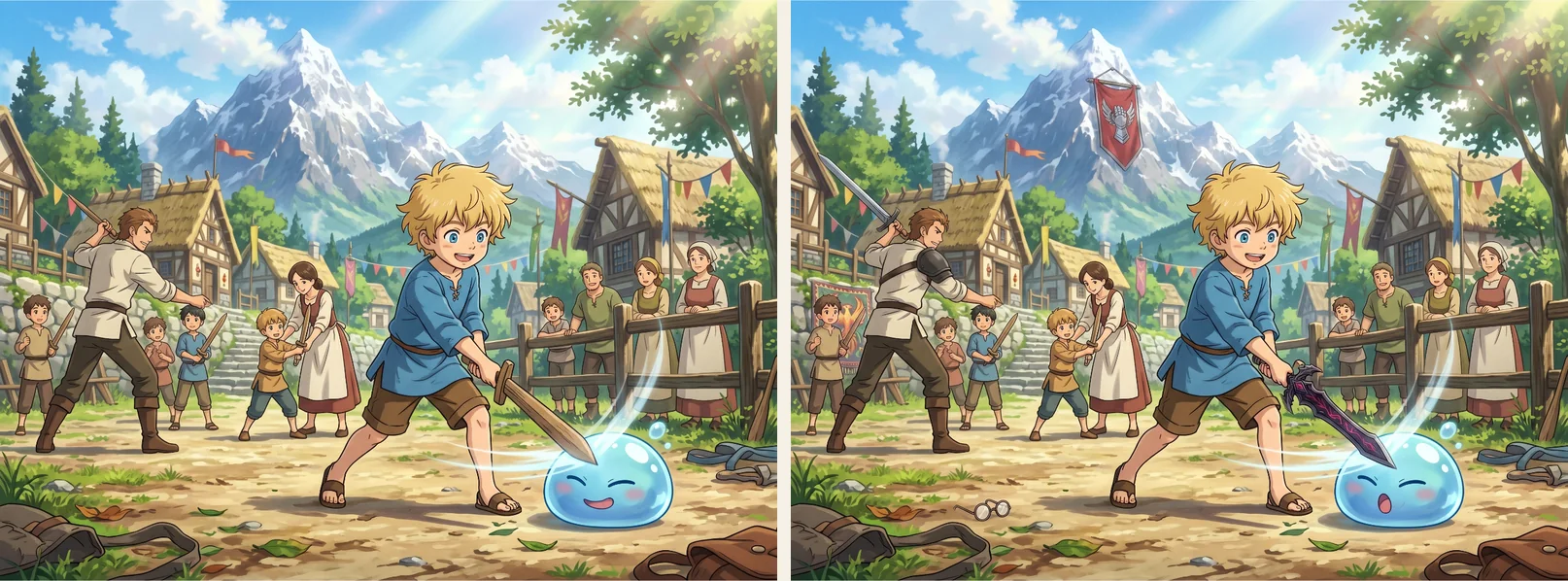
Stars are probably the least obvious part of the game. Why did I get three stars on this level and one on the next, when I was faster on the second? Does replaying count? What does "faster than 64% of players" actually compare?
Fair questions. The scoring does make sense, but you can't see how it works from the outside. So this is the full explanation, nothing left out.
Every difference is scored on its own
The game doesn't just look at how long the whole level took you. It records the moment you found each difference, counted from the start of the level.
For each difference, we keep the times of recent players who found that exact difference, and take the median. That's the value in the middle: half of the players were faster, half were slower. We use the median instead of the average because of the people who open a level, go make dinner, and come back an hour later. A single one of those would ruin an average. The median doesn't care.
Then it's simple:
| Your time for that difference | Stars |
|---|---|
| At or below the median | 3 (1 for finding it, 2 bonus for speed) |
| Above the median | 1 |
When a level is brand new and there's no data yet, every difference counts as fast. So being one of the first players on a new level pays off.
This is also why one nasty difference doesn't wreck your result. If you find four quickly and then spend three minutes on the fifth, you still keep the full stars for the first four.
It also explains the question from the top. Being faster overall doesn't help if you lose time on the differences that most people find quickly. The game compares you difference by difference, not level by level.
The big stars on the results screen
The one to three stars you see at the end are a separate thing. They summarize how you did against other players. Three means you were at least as fast as the typical player on every difference. Two means you beat them on more than half. One means you finished, which is worth something too.
If every single difference was fast, the level is also marked gold in your pack progress.
"Faster than X% of players"
This one compares your total time for the level with the completion times of recent players on the same level. "Faster than 70%" means 70 out of 100 recent players needed longer than you. Only people who finished count, and because it's based on recent games, the number shifts a little as more people play.
What counts as time
Only active play time. If you switch to another app or browser tab, the clock stops and starts again when you're back. So if someone calls you in the middle of a level, go ahead and answer.
Wrong taps don't cost stars directly. They cost time, though, and time is what everything is based on. Tapping randomly all over the picture is almost always slower than just looking properly.
Hints are allowed. You have three, and a used hint recharges after five minutes. A hint shows you where one difference is, but the clock keeps running until you tap it. With Premium, hints are unlimited.
Replays
You can replay any level you've unlocked. Your total only goes up if you get more stars than your previous best on that level. Nine stars the first time and thirteen on the replay means four stars get added. If the replay goes worse, nothing is taken away.
So replays can only help. But you can't farm the same easy level over and over either, which is kind of the point.
Within a pack, levels unlock one after another. Most packs start with easier levels and get harder, and unlocking in order keeps that curve intact.
The leaderboard
The leaderboard ranks players by total stars across all packs, official and community. You need to be signed in to show up. Guests can play everything, but they're not on the list. It shows your username, which you can change in your profile.
The leaderboard isn't recalculated after every single level. It's refreshed at intervals, so new stars can take a little while to show up there. That's not a bug, even though it looks like one.
If you want more stars
Take a relaxed look at the whole picture first and grab the obvious differences. Those are the ones where beating the median is easiest. After that, search in zones instead of jumping around. And when one difference takes forever, don't stress about it. It only affects the stars for that one.
We collected more of these habits in 10 ways to get better at spot the difference. And if something about scoring is still unclear, just email us. The address is in the imprint.